Your pet’s eyes are one of the most delicate and telling parts of their health. A subtle change in appearance, a new squint, or unexpected discharge can signal something that, if left unaddressed, may progress quickly and put your pet’s vision at risk. Many pet owners notice something seems off but aren’t sure when it rises to the level of a veterinary concern. The truth is that with eye health, the window for effective treatment is often shorter than owners realize.
At Montclair Veterinary Associates, we take eye health seriously as part of the comprehensive care we provide to pets across Northern NJ. Led by Dr. Cory Waxman, a graduate of the University of Pennsylvania School of Veterinary Medicine with a background in biochemistry from Northwestern University, our team has been evaluating and treating pets in this community for more than a decade. Whether your dog is showing signs of clouding of the lens, or your cat is dealing with persistent tearing and redness, we are here to assess what is happening and guide you on the right course of action.
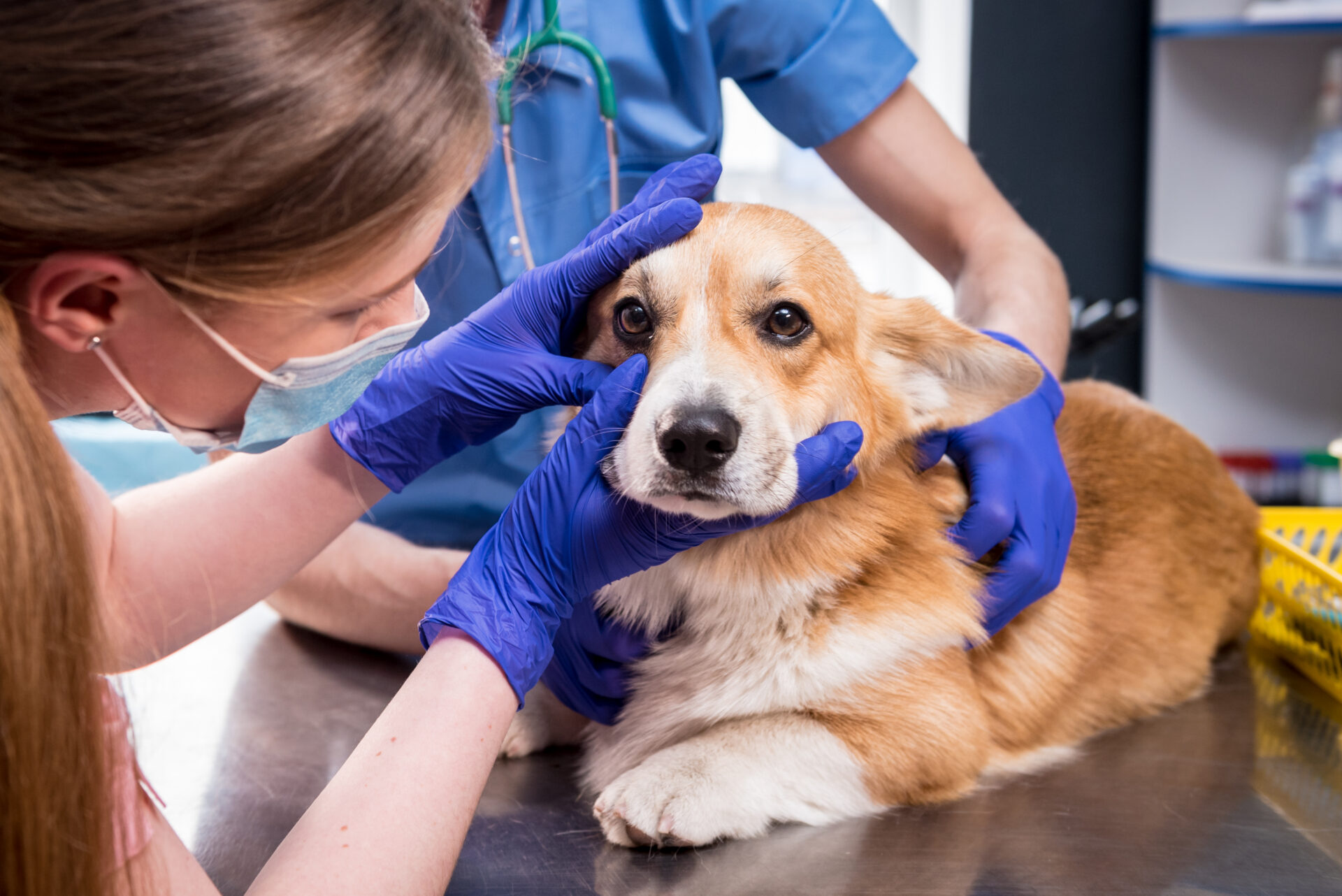
Eye conditions in pets are more common than many owners expect, and several of the most frequently seen issues can develop gradually before becoming obvious. Routine physical examinations include a basic assessment of your pet’s eyes, and catching changes early gives us far more options when it comes to managing discomfort and preserving vision. We encourage you to think of eye health not as a separate concern but as an integrated part of your pet’s overall veterinary care.
Unlike humans, pets cannot tell you when their vision is declining or when one eye is bothering them more than the other. They adapt, compensate, and continue their routines even when something is wrong. This makes regular professional evaluation especially important, as subtle changes in the eye that go unnoticed at home can be identified through a thorough clinical exam.
When you bring your pet in with a concern about their eyes, we perform a focused assessment that considers both the visible structures of the eye and the clinical context of your pet’s overall health. We look at the eyelids, the conjunctiva, the cornea, lens clarity, and any discharge or abnormal tearing. We also evaluate whether the condition appears to be acute or part of a longer-term pattern.
This evaluation is built into our routine health examinations as a standard component of preventive care. Catching early signs of issues like dry eye, glaucoma, or cloudiness at an annual visit often means a much simpler path to treatment compared to addressing a condition that has progressed over time.
Noticing a change in your pet’s eyes? Squinting, redness, or discharge shouldn’t wait. Contact our office to schedule an evaluation.
Eye problems in pets span a wide range of causes and severity levels. Some are mild and respond quickly to treatment, while others require ongoing management. A few of the conditions we commonly evaluate include the following:
Each of these conditions benefits from timely evaluation. You can read more about when eye symptoms call for immediate attention on our page covering eye problems in pets.
Brachycephalic breeds represent a notable portion of the patients we see at our practice, and these dogs and cats face a higher-than-average risk of eye-related problems. The shallow orbits and prominent eyes common to breeds like Pugs, Bulldogs, and Persian cats leave the eye more exposed and more vulnerable to injury, irritation, and conditions like corneal ulcers and dry eye.
For flat-faced pets, routine eye monitoring is not optional. We incorporate targeted eye assessment into every visit for brachycephalic patients, and we work with owners to establish home care habits that reduce the risk of irritation building into something more serious. Breed-specific health considerations often overlap with other systems in the body, and eye health is frequently connected to the broader picture of chronic and recurring conditions that these breeds are prone to developing over time.
When an eye condition is not straightforward, we draw on our practice’s in-house diagnostic capabilities to provide a clearer picture. Bloodwork, imaging, and other tools help us determine whether an eye issue is isolated or connected to an underlying systemic condition. For cases that require further evaluation beyond our scope, we coordinate with veterinary ophthalmology referral partners to ensure your pet gets the care they need without unnecessary delays.
We do not position ourselves as a board-certified ophthalmology practice, but we are equipped to evaluate, diagnose, and manage many common eye conditions in general practice, and to guide you appropriately when a referral is the right next step.
Your pet’s vision is part of their quality of life, and protecting it starts with a relationship with a veterinarian who knows them well. Dr. Waxman and the team at Montclair Veterinary Associates have been providing comprehensive veterinary care to dogs and cats in the Montclair area for more than a decade. We take the time to understand your pet’s individual history, breed-specific risks, and the changes you are noticing at home, so that we can offer guidance rooted in both clinical knowledge and genuine care for your animal.
If your pet is showing any signs of eye discomfort, changes in appearance, or anything that does not look quite right, do not wait. Reach out to our team through our contact form to schedule an evaluation and give your pet’s eyes the attention they deserve.
Montclair Veterinary Associates
Noticing redness, squinting, or discharge? Our team is here to help.
Some signs warrant same-day attention rather than waiting for a routine appointment, including sudden squinting, a visibly cloudy or enlarged eye, significant redness, or your pet pawing persistently at one eye. Conditions like glaucoma and corneal ulcers can worsen quickly and are painful, so it is always better to call our office and describe what you are seeing rather than waiting to see if it resolves on its own.
Brachycephalic breeds like Pugs, Bulldogs, and Persian cats have shallow eye sockets and prominent eyes, which leaves the surface of the eye more exposed and more vulnerable to injury, irritation, dryness, and corneal ulcers. Because of this anatomy, routine eye monitoring is a standard part of every visit for our flat-faced patients, and we help owners build home care habits that catch minor irritation before it becomes a bigger problem.
Cataracts develop when proteins in the lens clump together and cloud the eye, progressively impairing vision over time. They can be hereditary in certain breeds, or they may develop as a result of an underlying metabolic condition such as diabetes. Because of this connection, a full health workup is typically part of evaluating a pet with cataracts, rather than treating the eye in isolation.
Cherry eye occurs when the gland of the third eyelid prolapses, appearing as a pink or red mass at the corner of the eye, and it is most common in brachycephalic breeds like French Bulldogs, Pugs, and Boston Terriers. While not always an emergency, it should be evaluated promptly, since the exposed gland is more vulnerable to irritation and the condition rarely resolves entirely on its own without treatment.
Not necessarily. We are equipped to evaluate, diagnose, and manage many common eye conditions in general practice, including conjunctivitis, dry eye, and cherry eye. For cases that are more complex or require specialized surgical intervention, we coordinate with veterinary ophthalmology referral partners so your pet gets the right level of care without unnecessary delay. We do not position ourselves as a board-certified ophthalmology practice, and we will always be upfront with you about when a referral is the better path.
We use cookies to improve your experience on our site. By using our site, you consent to cookies.
Manage your cookie preferences below:
Essential cookies enable basic functions and are necessary for the proper function of the website.
CloudFlare provides web performance and security solutions, enhancing site speed and protecting against threats.
Service URL: developers.cloudflare.com (opens in a new window)
These cookies are needed for adding comments on this website.
Google reCAPTCHA helps protect websites from spam and abuse by verifying user interactions through challenges.
Google Tag Manager simplifies the management of marketing tags on your website without code changes.
WPForms is a user-friendly WordPress plugin for creating custom forms with drag-and-drop functionality.
Statistics cookies collect information anonymously. This information helps us understand how visitors use our website.
Google Analytics is a powerful tool that tracks and analyzes website traffic for informed marketing decisions.
Service URL: policies.google.com (opens in a new window)
Clarity is a web analytics service that tracks and reports website traffic.
Service URL: clarity.microsoft.com (opens in a new window)
Marketing cookies are used to follow visitors to websites. The intention is to show ads that are relevant and engaging to the individual user.
Google Maps is a web mapping service providing satellite imagery, real-time navigation, and location-based information.
Service URL: policies.google.com (opens in a new window)